Where a Body Care Timeline Loses Weeks: Seven Mistakes
Body care timelines rarely collapse in one dramatic event. They lose days at the edges: a brief that leaves the pack undecided, a sample approved from a photo, a market chosen after the label artwork was set. Each of those costs a week or two, and they compound. The mistakes below are worth reading as a list of decisions to make early, because every one of them is cheap at the start and expensive in the middle.
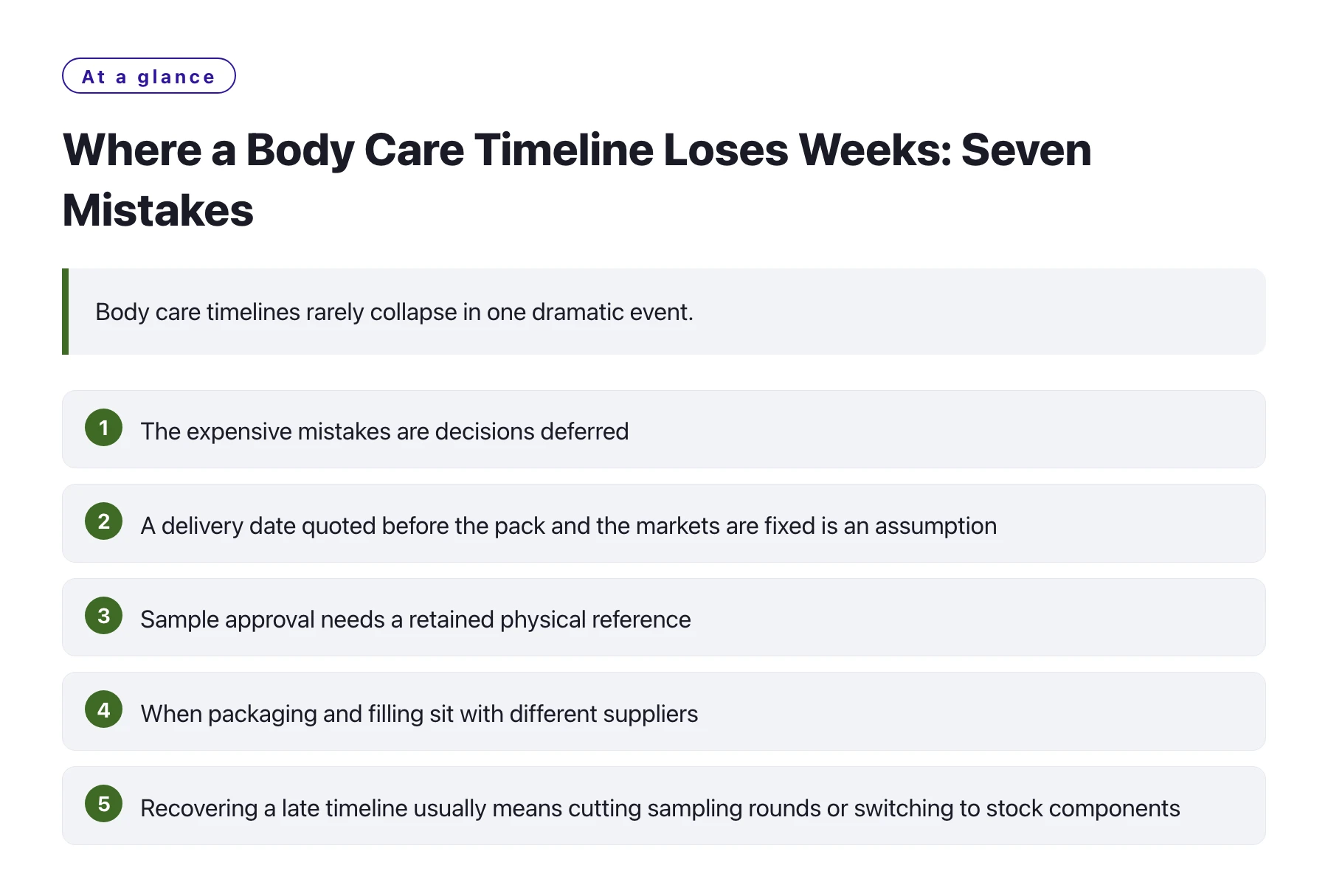
Key takeawaysThe expensive mistakes are decisions deferred, not tasks performed slowly: pack format, target market and approval method all belong at the beginning. · A delivery date quoted before the pack and the markets are fixed is an assumption, and it should be labelled as one in your own planning documents. · Sample approval needs a retained physical reference; approval by photograph transfers the risk of the difference to the brand. · When packaging and filling sit with different suppliers, someone has to own the interface between them or the schedule will find the gap. · Recovering a late timeline usually means cutting sampling rounds or switching to stock components, so it pays to know which of those you are willing to trade.
Almost every conversation about a late body care launch ends with the same explanation: the factory was slow, or the component supplier was slow. Sometimes that is true. More often, the schedule was built on decisions that had not been made, and the first time anyone noticed was when a date passed.
The useful way to read the following list is not as a warning about suppliers. It is a list of choices that belong to the buyer, and each one can be settled in a single meeting if it is raised early enough.
If your launch date is already fixed, the sections on recovery at the end matter more than the diagnosis.
Where a body care schedule actually breaks
Body care projects combine two tracks that fail in different ways. The fragrance track fails slowly and visibly — you can smell a wrong direction in the first sample. The packaging track fails quietly, because a cylinder, mould or dieline is being manufactured somewhere else and produces no feedback until it arrives.
That asymmetry is why the same mistake costs different amounts on the two tracks. A vague fragrance brief costs a sampling round; a vague packaging brief costs the time it takes to remake a tool.
Mistake one: treating the delivery date as one number
A single date hides which track is driving it. Ask for the schedule split into fragrance development, component production, documentation and filling, then look at which of those is the longest. That is the track to manage, and it is not always the one buyers assume — the questions worth putting to a supplier are set out in a guide to how to compare perfume factories, and the split timeline is the first thing to request.
Mistake two: briefing the fragrance before deciding the pack
Fill volume, dispenser type and material all affect how a concentrate behaves and how much of it the finished unit contains. A fragrance developed for a pump-action lotion is not automatically the right fragrance for an airless pack or a tube, and rediscovering that after the bulk has been ordered is an expensive way to learn it, because the use limits that apply to individual fragrance materials are set per product category [3].
The remaining five, in the order they usually appear
- Approving samples from photographsA photograph cannot show how a scent blooms on skin, and it cannot be compared against a reference. Ask for a retained physical sample from the approved batch, held by both sides, with a date and a batch reference.
- Choosing the market after the label is designedIngredient naming, allergen declaration and language requirements differ by market, and a label designed before that choice often has to be redrawn.
- Splitting packaging and filling with no ownerTwo suppliers can each be on time while the project still slips, if nobody owns the handover point. Name the person who confirms that the components and the bulk are ready in the same week. Packaging material and recyclability questions sit in the same handover, and packaging guidance is where those requirements are spelled out [1].
- Assuming a change of base is a small changeSwapping a cream for a lotion or changing the preservative system can invalidate stability work already completed, which restarts a stage that had been closed. This is one of the cautions that formulation and testing guidance keeps repeating [2].
- Planning a reorder on the original timelineA repeat order is usually faster, but only if the artwork, the components and the formula are unchanged. Confirm all three before promising a shelf date to a retailer.
What to do instead
The countermeasures are unglamorous. Freeze the pack format before the fragrance brief is signed off. Choose the destination markets in the same meeting. Agree in writing what counts as sample approval. Put a name against every handover.
None of that requires a bigger budget, which is why buyers who have run a few launches tend to do it automatically. It is also the reason a first-time buyer can close most of the gap simply by asking the questions in the right order.
A manufacturer that handles formulation, bottle and packaging design and filling as one scope removes one class of interface risk, because the internal handovers are theirs rather than yours. That is not an argument for ignoring the packaging question, since a supplier set up as fragrance manufacturing under one roof should still be able to show you the component timeline separately — it just means fewer people have to agree for the project to move.
Recovering a week you have already lost
When the date is fixed and the schedule is short, the options are limited and they all involve a trade. Cut a sampling round by choosing from existing directions. Switch a bespoke component for a stock one. Split the launch so the fastest-moving part of the range ships first.
What does not work is compressing the documentation stage. Tests take the time they take, and a certificate produced early is a certificate that does not describe the goods.
Deciding which trade you can accept
Write down which of the three trades above you would accept before the situation forces the choice. Buyers who have decided in advance usually make the decision in a day; buyers who have not tend to spend a week collecting opinions while the schedule keeps running.
Symptom, cause and the fix that works
| Symptom you notice | What it usually means | What to do instead |
|---|---|---|
| The sample smells right but looks wrong in the pack | The pack format was decided after the fragrance | Freeze the pack before the brief is signed off |
| Two approvals, two different opinions | No agreed approval reference | Retain a sealed physical sample and label it |
| Components arrive after the bulk is ready | Nobody owns the handover between suppliers | Name one owner and put the handover date in the schedule |
| Stability has to be repeated | The formula or the pack changed mid-project | Sign off formula and pack material together |
| A reorder takes as long as the first order | Artwork or components changed without being recorded | Keep a locked specification file for each finished product |
Every row in that table has the same root: a decision that was left open. Opening a decision is free; leaving it open costs weeks.
The cheapest schedule improvement available to a body care brand is a one-page project charter signed at the start: pack format, fill volume, destination markets, approval reference and the name of the person who signs off. It takes an hour to write and it removes most of the events on this list.
Reading a supplier's answer for warning signs
When you put the timeline questions to a supplier, listen for how the answer is structured rather than how confident it sounds. A supplier who separates the fragrance track from the packaging track, and who asks which markets you are selling into before quoting a date, is describing a process they run often.
A supplier who offers one date and no assumptions is not necessarily inexperienced, but you have no way to tell from the answer alone. Publishing a service scope is one way a manufacturer makes itself checkable before the first meeting, and it is a reasonable thing to look for in Xuelei Fragrances or any other partner you are considering.
The point of all this is not to make the schedule longer. It is to make the date you promise a retailer one you can still recognise three months later, when the artwork has changed twice and the launch window has moved.
Sources
- Sustainable Packaging Coalition —— A membership organisation working on more sustainable packaging design, publishing material and recyclability guidance.
- Cosmetics & Toiletries —— A technical magazine for cosmetic formulators, covering ingredients, formulation science and testing methods.
- IFRA Standards Library (International Fragrance Association) —— The IFRA Standards Library lists the restrictions the fragrance industry applies to individual fragrance ingredients, based on safety assessments; it is the reference point for compliant fragrance formulation.
Frequently asked questions
Is a late launch usually the factory's fault?
Sometimes, but the more common cause is a decision that stayed open, and most of those decisions belong to the brand. Market selection, pack format, artwork and sample approval are the four that move dates most often. Ask which of them is currently open before assuming the factory is behind.
How many sampling rounds should I budget for a body care fragrance?
Plan for more than one and ask the supplier to state how many rounds the quotation includes. A single round is realistic when you are selecting from existing directions and unrealistic when you are briefing something genuinely new for a base that has not been used before.
Can I use stock packaging to protect the launch date?
Yes, and it is the fastest lever available. Stock bottles, tubes and pumps remove the tooling stage entirely, and decoration can still make the pack look proprietary. The trade is differentiation, which is a marketing decision rather than a production one.
What should a sample approval record contain?
A sealed physical sample from the approved batch, the date, the batch or reference number, the formula revision and the name of the person approving on the brand side. Both parties should hold a copy. Photographs can support the record but should not replace it.
Does a single supplier for fragrance and packaging make the schedule shorter?
It removes interfaces, which is where a lot of slippage hides, but the underlying queues remain. Ask for the component timeline separately even when one supplier covers both, so you can still see which track is driving the date.