Leaving Solo Mining for Steady 0.05 BTC Steps
Solo mining offers a lottery ticket with a very long odds board. At 100 TH/s the expected wait for a block is roughly 190 years, while the same machine on a pool produces 0.00004486 BTC a day and reaches 0.05 BTC in 1,114.6 days. The coin total is smaller than a block reward and arrives in a shape a household can actually plan around.
Key takeaways
- At 100 TH/s, finding a block alone has an expected wait of about 190 years at current difficulty.
- The same machine on PPS+ earns 0.00004486 BTC a day, reaching 0.05 BTC in 1,114.6 days.
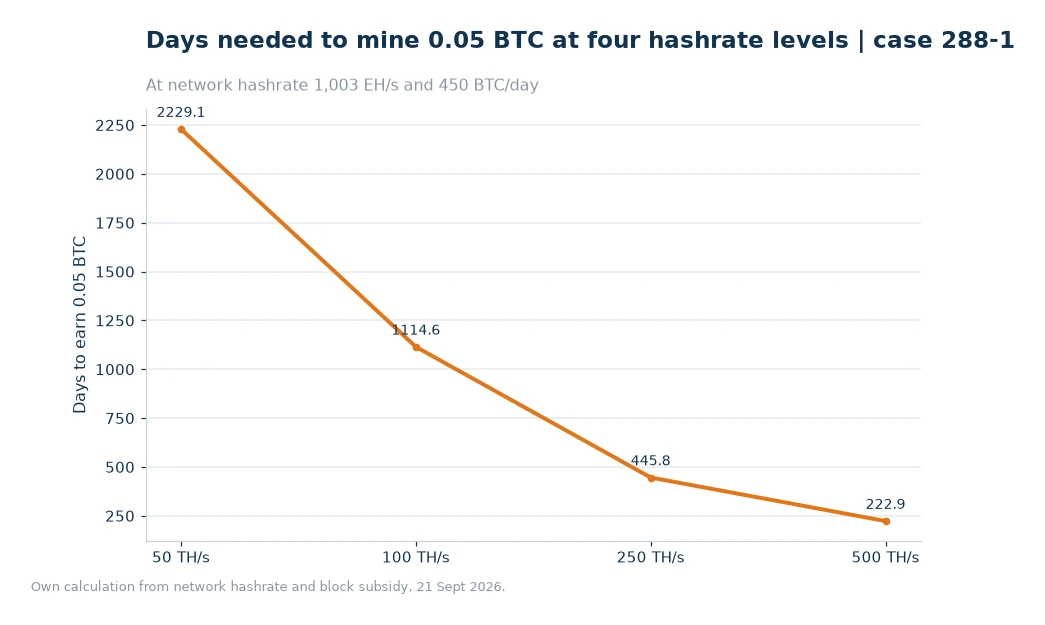
- Doubling hashrate halves the wait: 500 TH/s needs 222.9 days for the same target.
- 0.05 BTC is worth about $4,234.60 at $84,692, and the coin amount is fixed while the dollar value is not.
What solo mining actually promises
Solo mining pays the full block reward to whoever finds the block, which is 3.125 BTC plus transaction fees at the September reading. That is a large number, and it is the reason the idea persists. The probability attached to it is the part that gets less attention: at 100 TH/s against 1,003 EH/s, the machine holds about one ten-millionth of the network.
Expected time follows from that share. A block arrives every ten minutes across the whole network, so a machine with one ten-millionth of the hashrate waits about ten million blocks, or roughly 190 years, for one on average. The word average is doing heavy lifting. A solo miner might find one next week and never find another, and no schedule can be built on that.
There is also a cash-flow problem that has nothing to do with odds. A solo miner pays for power every month and receives nothing for years at a time. Even a technically sound setup becomes difficult to sustain when the only inflow is an event that may not happen inside the hardware's life, which is why so many solo experiments end before the first block rather than after it.
The pool view of the same hashrate
A pool changes the unit of payment from a block to a share. The machine still submits the same work, but the reward is divided across everyone contributing, weighted by hashrate. The result is smaller and far more frequent. Under PPS+ the block-reward component is settled hourly against current difficulty, so the payout does not depend on who found the last block, which is the property that makes planning possible at all.
This is the trade in plain terms: certainty of amount against size of amount. A pool cannot make a small machine produce a block reward, and it does not pretend to. What it does is convert an event with a 190-year expected wait into a daily figure that can be compared with a power bill, which is the only way most operators can run the arithmetic at all.
The hourly rhythm matters more than it sounds. A miner who sees a credit every hour can catch a failed fan on the same day, while a solo operator has no feedback until a block appears or a temperature alarm fires. Frequency of payment and frequency of diagnosis turn out to be the same thing, which is why the switch feels less like a financial decision and more like adding instruments to a machine that previously ran blind.
Four hashrates against a 0.05 BTC goal
Each row uses the same network inputs, so the differences come entirely from hardware. A year is counted as 365.25 days.
| Machine | BTC per day | Days to 0.05 BTC | Years |
|---|---|---|---|
| 50 TH/s | 0.00002243 | 2229.1 | 6.1 |
| 100 TH/s | 0.00004486 | 1114.6 | 3.1 |
| 250 TH/s | 0.00011215 | 445.8 | 1.2 |
| 500 TH/s | 0.00022430 | 222.9 | 0.6 |
Six years is longer than the useful life of most mining hardware, which is the uncomfortable fact hiding in the first row. A 50 TH/s unit will probably be retired before it reaches 0.05 BTC at today's difficulty, let alone a higher one. Choosing a target that outlives the machine is the quiet mistake in many small solo-to-pool migrations, and it is cheaper to fix the target than the hardware.
Worked example
The comparison between solo and pooled output comes from the same two numbers.
- Share of network at 100 TH/s: 100 ÷ 1,003,000,000 = 9.97e-08.
- Expected blocks per day: 144 × 9.97e-08 = 1.44e-05.
- Expected wait for one block: 1 ÷ 1.44e-05 = 69,444 days, or about 190 years.
- Pooled daily output: 100 × 0.00000044865 = 0.00004486 BTC.
- Days to 0.05 BTC: 0.05 ÷ 0.00004486 = 1,114.6 days.
- Value of the target: 0.05 × 84,692 = $4,234.60.
Pool Luck and the end of the wait
Pool Luck is the measure a former solo miner finds most familiar, because it describes the same randomness that made solo mining unbearable. It compares blocks found with blocks expected for the pool's share of the network. On PPS+ that comparison is informative rather than financial: the credit is settled against difficulty, so a lucky streak at the pool does not land in your balance.
The ViaBTC BTC Mining Pool page shows Pool Hashrate and Pool Luck next to each other. For someone arriving from solo mining, the useful lesson is that both figures describe a collective, not a personal outcome. Your 100 TH/s earns the same hourly credit whether the pool is fortunate or not.
Hardware that ages during a long target
A 1,114.6-day schedule assumes the machine runs at its rated hashrate for three years and that difficulty stays where it is. Neither will hold. Fans wear, thermal paste dries, and difficulty has mostly risen over time. The practical effect is that the real date drifts later than the calculated one, sometimes by a wide margin.
Dust is the cheapest variable to control and the most commonly ignored. A machine in a clean room holds its hashrate for years; one in a shed with a single filter loses it in months. Since the schedule assumes full rated output, anything that throttles the board quietly rewrites the calendar in the wrong direction.
A shorter target is easier to defend. At 500 TH/s the 0.05 BTC line arrives in 222.9 days, which is inside a single hardware generation and survives a difficulty change or two without becoming fiction. The network statistics page is the place to watch those inputs move, and the listed fee schedule confirms which rate applies to which component before the comparison is made.
Frequently asked questions
Is pooled mining worse than finding a whole block?
It pays less per event and far more often. At 100 TH/s a block has an expected wait of about 190 years, while the pool credits 0.00004486 BTC a day, which is a figure you can compare with costs.
Why does 0.05 BTC take over three years at 100 TH/s?
Because 100 TH/s produces 0.00004486 BTC a day at current difficulty, and 0.05 ÷ 0.00004486 is 1,114.6 days. The target is large relative to the machine's share of the network.
Does Pool Luck change what a PPS+ miner receives?
No. PPS+ settles the block-reward component hourly against current difficulty, so a run of good or bad luck at the pool does not alter the credit.
Move the machines, keep the target
Switching from solo to pooled work does not require new hardware, only a change of address and a decision about the payout scheme. Point the machines at the pool, confirm the worker names, and give it 72 hours. If the credits at 100 TH/s average 0.00004486 BTC a day, the migration is complete and the 0.05 BTC target has a date again.
Sources: pool state, statistics and pricing pages at viabtc.com[1]. On 21 Sept 2026 the network ran at 1,003 EH/s with 132.76 T difficulty, a 3.125 BTC subsidy and BTC at $84,692. Read that day, published 24 Oct 2026; waits presume flat difficulty and continuous uptime.